In the beginning was the Word, and the Word was with God, and the Word was God. The same was in the beginning with God.
John 1:1
My middle daughter Paula has been married to Jamal Brown for 26 years now and they’ve taught us to expect only the extraordinary from them. One of the earliest signals sounded as we sat in expectation at the beginning of their wedding ceremony. The church was filled, the mothers had been seated, and yet, there was neither groom nor best man at the altar rail as tradition would dictate. With neither warning nor preparation, the voice of Joseph Macon, a family brother, loudly proclaimed, “The groom is coming! The groom is coming!” What on earth, as my daughter Toni might have asked. What on earth was going on? We’d never experienced this before. And not since, actually.
Our bewilderment at this unexpected announcement might have been comparable to that engendered among the people who heard John the Baptist’s announcement. More than once, every chance he had, John the Baptist talked vehemently about this one who was coming after him; this one younger than he; this one greater than he. His audience had to bring their curious selves to hear him more than once; see him preach about this one. John the Baptist was strange enough on his own. He kept himself separate from the rest of the villagers. He often fasted and prayed for many days. And when he did eat, he ate locusts and honey. Healthy. But unusual, even in that day. He wore strange clothes and looked with the glassy stare often brought on with strenuous fasting.
But his message was sound. The voice of one crying in the wilderness. The voice of one with an unusual message. The voice of one whose message was irresistible in that the people kept coming to hear him, hoping to gain clarity, hoping to hear something new, hoping to understand why Zechariah and Elizabeth’s son had always been so different from his peers.
They had no way of understanding that John’s gifting was prophetic and for his entire life he would proclaim the coming of a savior who would institute the kingdom of God in their midst and turn their world upside down. He couldn’t help himself. It was woven into the fabric of his being by the hand of God in his mother’s older than traditional womb, with supernatural precision. John experienced the joy of Jesus with just the announcement of his coming. When Jesus’ mother sought comfort with her cousin Elizabeth, the sound of Mary’s greeting made the babe John leap within his mother’s womb. He was fated to carry this message and carry it he did for the entirety of his life. And he let nothing dissuade him. Not his time in the desert. Not the obvious disdain some neighbors must have had for his unwillingness to conform. Nothing.
And his message was vindicated as the one he’d proclaimed began to show himself…Behold the Lamb of God who takes away the sin of the world. Behold this one whose shoe laces I’m unfit to tie. John said he wasn’t fit to be this one’s servant. This Lamb. This Savior. This Son. This Logos of God.
The one the gospel writer embraced at the beginning of the book…In the beginning.
In the beginning was the word…a parallel to the Genesis beginning that listed God alone. The word was God. The word was with God. The word was God. The same was in the beginning. Word first. Word before all things. Word now. Word for eternity.
John set us up with a cosmology and a theology. No world without God. No world without Word. The Word is God. That Word that needs capitalization is God, was with God and is eternally God.
Jesus’ first disciple had belonged to John the Baptist’s group…Andrew, and he went to fetch his brother Simon. And these were the beginning of the twelve who laid down nets and relationships to follow this one, this Jesus, the son of God. Andrew brought Simon Peter who Jesus called Peter. In Galilee Jesus met Philip who found Nathaniel. As Andrew told Simon Peter, “We have found the Messiah,” Philip told Nathanael, “We have found the one Moses and the Prophets wrote about. He is Jesus, the son of Joseph from Nazareth.” To which Nathaniel inquired whether or not anything good could come out of Nazareth. Philip told him to come and see.
These were the first of Jesus’ group; they would become convinced learners and ultimately do all they would see him do.
He chose men who were physically strong. They had to manage the fishing nets that were wide enough to be quite heavy since they were also weighted to surround and capture the catch of the night. He chose men who were intellectually strong in that they asked the right questions, even though they seemed to pluck his last nerve at times. He chose men who were adept in business who could converse with people of different dialects and languages as their trade would require. He chose men who were bold enough to submit themselves as servants during his three year ministry on earth, and fearless enough, with the help of the Holy Ghost, to carry on the ministry he’d begun after his ascension. They left industry and family to see what this one meant when he spoke of kingdom and peace and grace and mercy. They left to find the true meaning in the stories he told and the lessons he taught. They left to find themselves in this new relationship they had no way of understanding in the beginning. But somehow they knew it was their destiny and they accepted the challenge.
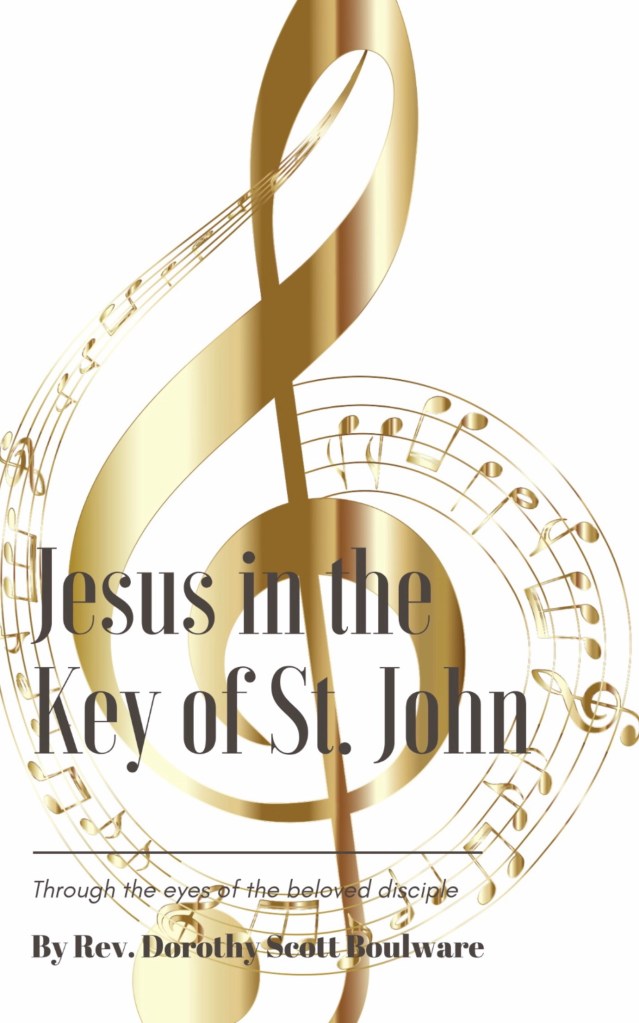
This is excerpted from “Jesus in the Key of St. John,” available on the “Books and Other Things” page.
 Dorothy Scott Boulware